For many people with severe physical disabilities, controlling a power wheelchair can be challenging or impossible using a conventional joystick. This is where assistive technology can transform mobility.
The MyEcc Prop, developed by HomeBrace, uses eye-control technology to translate a person's eye movements into commands for a power wheelchair. Instead of relying on hand, arm, or head movements, the system allows the user to interact with the wheelchair through an existing eye-gaze communication device.
But how does this technology actually work?
From Eye Movement to Wheelchair Movement
At the heart of MyEcc is a relatively simple idea: turn visual attention into a control signal.
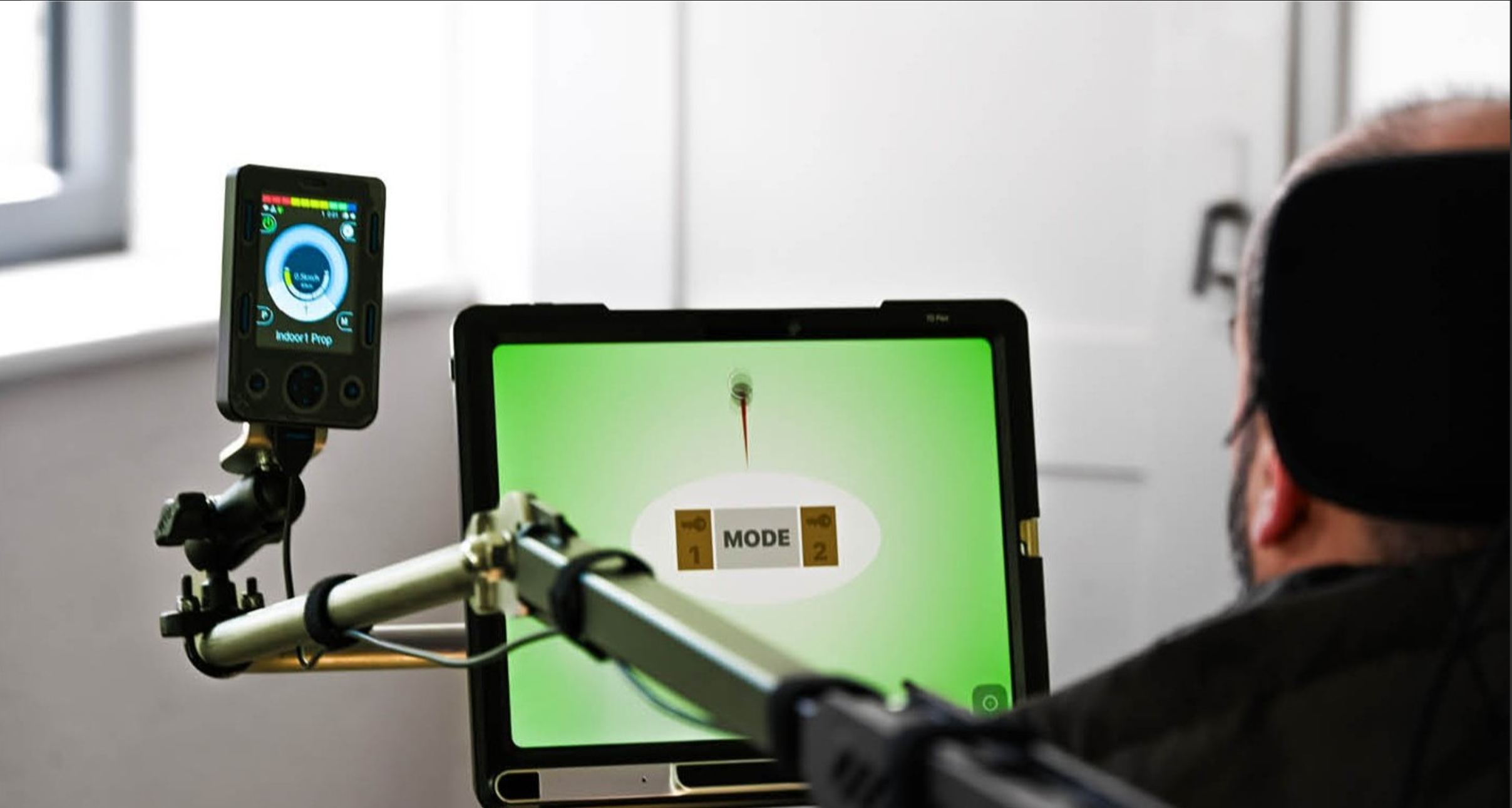
An eye-gaze communication device tracks where the user is looking. The MyEcc software then uses this interaction to generate directional commands. On the display, the user can target directional arrows, effectively using their gaze in place of a traditional mouse or joystick. These commands are then transmitted through the MyEcc Prop interface to the wheelchair's electronic control system.

The process can be understood in four stages:
1. Eye tracking
The communication device detects where the user is looking.
2. Software interpretation
MyEcc interprets the user's interaction with the on-screen controls.
3. Command transmission
The MyEcc Prop acts as the interface between the software and the wheelchair.
4. Wheelchair response
The wheelchair receives the command and moves in the selected direction.
This creates a direct interaction between the user's eyes and the wheelchair.
From Eye Movement to Wheelchair Movement with MyEcc Pupil Prop
MyEcc Pupil Prop offers an alternative approach to eye-controlled wheelchair mobility, using a dedicated eye-tracking sensor integrated into glasses. Control your power wheelchair safely with just your eyes – indoors and out!
Instead of selecting commands on a communication device's screen, the system detects the direction of the user's gaze directly. The user's eye movements are interpreted as directional commands and transmitted through the MyEcc Pupil Prop interface to the wheelchair's electronic control system.
What makes MyEcc Pupil Prop absolutely unique is that it is the only eye-controlled assistive device for power wheel chairs that works outdoors and in bright sunlight. That’s why MyEcc Pupil Prop comes with phototropic lenses.

Click to visit product
The process can be understood in four stages:
1. Eye tracking
The sensor integrated into the glasses detects the direction of the user's gaze.
2. Software interpretation
MyEcc Pupil interprets the eye movement and determines the intended direction.
3. Command transmission
The MyEcc Pupil Prop acts as the interface between the eye-tracking system and the wheelchair.
4. Wheelchair response
The wheelchair receives the command and moves in the selected direction.
This creates a direct and intuitive connection between the user's eye movements and wheelchair movement, without requiring a conventional joystick and a display.
Designed for People with Very Limited Movement
One of the important aspects of MyEcc is that it does not depend on precise hand or arm movement. HomeBrace specifically describes the system as being intended for people who cannot use their body or head movements effectively to operate a wheelchair. It can also be used by people with conditions involving spasticity.
This is particularly significant in rehabilitation and assistive technology because the control method can be adapted to the person's remaining abilities rather than requiring the person to adapt to a conventional joystick.
The technology therefore changes the question from:
"Can this person operate a joystick?"
to:
"What movement can this person reliably use to communicate a command?"
For some users, the answer can be their eyes.
The Role of the MyEcc Prop Interface
The eye-gaze device and the wheelchair do not simply communicate directly with each other. The MyEcc Prop control box provides the technological bridge between the MyEcc software and the wheelchair's control system.
The system can work with power wheelchairs equipped with an appropriate switch-control interface. HomeBrace also states that it can be used with different wheelchair control systems, including R-Net, Linx and Dynamic Controls systems.
This approach is important because it allows the eye-control technology to become an additional method of controlling an existing power wheelchair rather than requiring a completely separate mobility platform.
More Than Forward and Backward Movement
Modern power wheelchairs provide much more than basic driving. They can incorporate powered seating functions, different driving speeds and other assistive technologies.
MyEcc can therefore be configured to access different wheelchair functions. Depending on the configuration, users can change seating positions and switch between different operating modes. The system can also be integrated with assistive robotic arms.
This makes eye control potentially useful beyond mobility.
A single access method can become a central interface for mobility, positioning and environmental interaction.
MyArm: Keeping the Technology in the Right Position
Eye-tracking technology depends on maintaining an appropriate relationship between the user's eyes and the control device.
This becomes particularly important when a wheelchair user changes position.
The MyArm mechanical support arm is designed to maintain the correct distance between the eye-control system and the user's eyes, including when the person is sitting, lying down or standing. HomeBrace describes it as a powder-coated stainless-steel mechanical arm mounted to the wheelchair's biomechanical length compensation system.
This illustrates an important principle of assistive technology: software alone is not enough.
Successful eye control requires the combination of:
- Eye-tracking technology
- Software
- Wheelchair electronics
- Appropriate positioning
- A stable mounting system
- Individual calibration and adjustment
The complete system must work together around the individual user.
Adding Cameras for Greater Awareness
Another interesting technological feature is the possibility of integrating camera views into the control interface.
With the Windows version, an additional rear-facing camera can be used to extend the user's field of view. The system can display the front or rear camera view depending on the direction of travel, while the transparency of the directional arrows and camera image can be individually adjusted.
This is more than a convenience feature. For someone controlling a wheelchair through a screen, maintaining awareness of the surrounding environment is an important part of safe and confident navigation.

The Move Towards Proportional Eye Control
The development of eye-controlled wheelchair technology is also moving beyond simple directional commands.
HomeBrace has introduced proportional eye control, allowing eye movements to be translated into smoother and more precise wheelchair control. The company's newer MyEcc V5 combines the MyEcc Prop and MyEcc Pupil Prop approaches into a unified system and adds proportional control and artificial-intelligence-based functionality.
This represents an important evolution.
Traditional switch-based control can essentially work as:
Look → Select → Move
Proportional control aims for a more continuous relationship:
Look → Direction and intensity → Smooth movement
The result can potentially make wheelchair operation more intuitive and precise.
From Communication Technology to Mobility Technology
Perhaps the most interesting aspect of MyEcc is that it builds on technology many users may already rely on for communication.
Rather than treating communication and mobility as completely separate systems, MyEcc allows an eye-controlled communication device to become part of the wheelchair control interface. The current system supports both Windows and iOS-based communication devices, expanding the range of devices that can potentially be incorporated into an assistive mobility setup.
This reflects a broader trend in assistive technology: using one person's existing access method to control multiple aspects of their environment.
For an individual who already uses eye gaze to communicate, the same fundamental interaction can potentially become a pathway to independent mobility.
Technology That Supports Independence
The technology behind MyEcc demonstrates how eye tracking, software, wheelchair electronics and mechanical positioning can be combined to overcome physical barriers.
The most important innovation is not simply the ability to track someone's eyes. It is the creation of a complete system in which eye movement becomes a practical control language.
For people who cannot operate a conventional joystick, this can open up possibilities for independent movement, seating adjustment and interaction with additional assistive technologies.
As eye-tracking technology continues to develop—with proportional control, improved compatibility, cameras and increasingly intelligent software—the boundary between communication and mobility is becoming increasingly connected.
Assistive technology is at its most powerful when it doesn't simply compensate for a limitation, but creates a new way for a person to interact with the world.
Information based on HomeBrace product documentation and published technical information. MyEcc configurations and compatibility should be assessed individually by an appropriately qualified assistive-technology professional.